

Level Of Development (LOD) in BIM
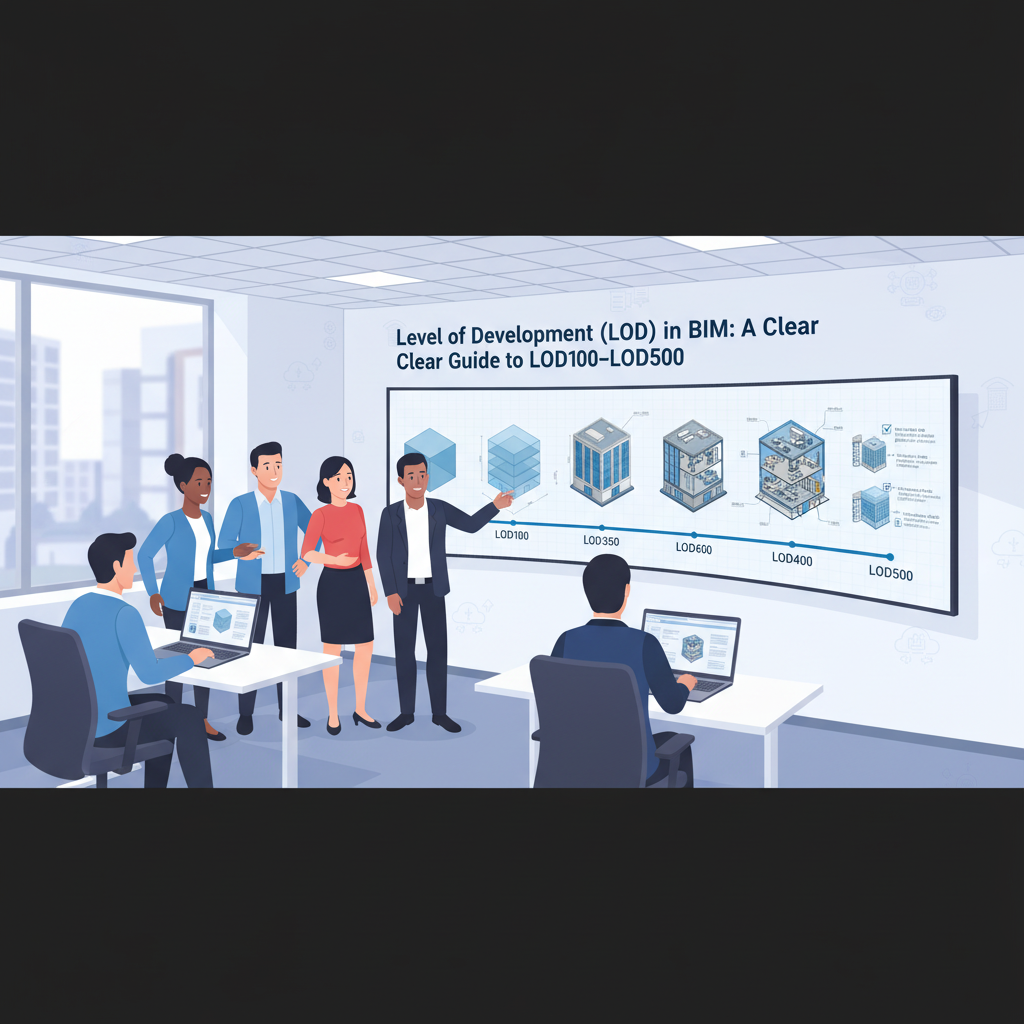
Level of Development (LOD) in BIM: A Clear Guide to LOD100–LOD500.
Published On : 05 Sep 2025
In Building Information Modelling (BIM), clarity and accuracy are everything. To ensure that every stakeholder understands exactly how detailed a model element should be at each stage, the industry follows a standardized framework known as the Level of Development (LOD). These LOD definitions—ranging from LOD100 to LOD500—help designers, contractors, and owners align expectations, avoid miscommunication, and deliver precise, reliable BIM data throughout a project’s lifecycle.
LOD 100 – Concept Design
At this earliest stage, the BIM model represents the project at a conceptual level. Elements are symbolic and used mainly for overall planning. Basic parameters like area, height, volume, orientation, and location are defined, helping outline the project’s initial vision.
LOD 200 – Schematic Design
Model elements take shape with approximate size, quantity, and positioning. The geometry is still generic, but more recognizable. Early non-geometric data can also be linked to elements, supporting initial cost estimates and design decisions.
LOD 300 – Detailed Design
Elements are
now modelled with accurate size, shape, quantity, location, and orientation. At
this level, the model becomes coordinated and reliable enough for detailed
drawings and design validation. Additional asset-related information may also
be embedded.
LOD 350 – Construction Documentation
This stage
provides clarity on how elements interact with other building systems.
Interfaces, connections, and supports are modeled to show real coordination
between structural, architectural, and MEP components—essential for clash
detection and documentation.
LOD 400 – Fabrication & Assembly
The model
becomes fabrication-ready. Elements include detailed assembly, installation
specifications, and precise dimensions, allowing contractors and fabricators to
produce and assemble components accurately.
LOD 500 – As-Built
This is the final, verified representation of what was
constructed. Elements reflect true field conditions, making LOD500 models ideal
for facility management, operations, and lifecycle planning.