

How BIM Works?
A Complete, Modern Guide to the BIM Workflow.
Published On : 28 Aug 2025
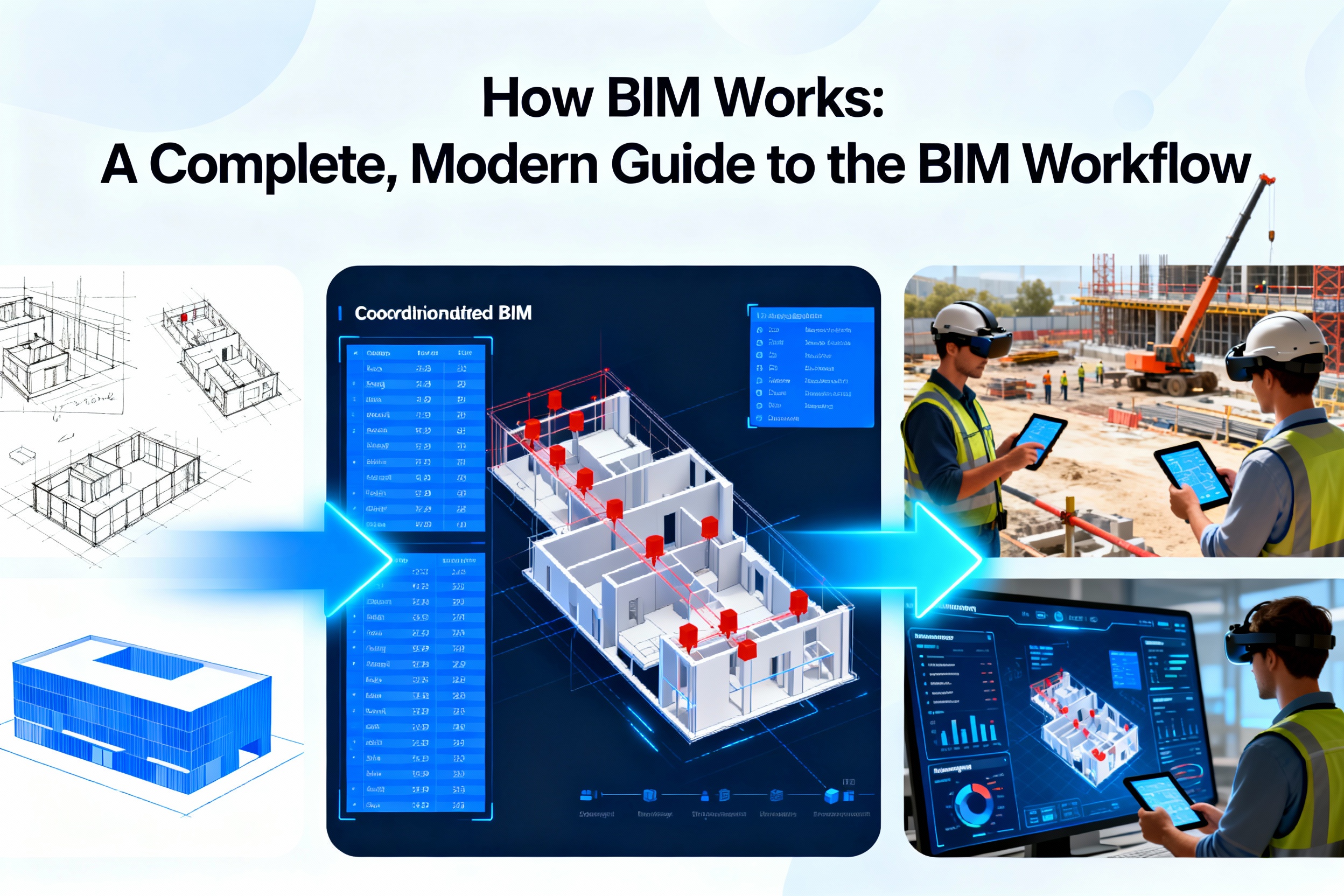
Building Information Modelling (BIM) is much more than a 3D model—it is a connected digital workflow that transforms how buildings are designed, constructed, and maintained. Instead of traditional siloes processes, BIM creates a collaborative environment where every stakeholder works from a shared source of truth. Here’s a clear, updated look at how BIM works across the full project lifecycle.
1. Planning & Conceptual Design
The BIM
process begins with a conceptual 3D model that visualizes the project early and
defines the design intent. Using site scans, sketches, or early design inputs,
teams can instantly analyse feasibility, site logistics, and preliminary cost
impacts. This early clarity helps prevent major design issues before they
develop.
2. Detailed Design & Development
Once the
concept is approved, different disciplines begin contributing to the digital
model. Architects, structural engineers, and MEP specialists add accurate
geometry and rich data to each building element. This is where BIM becomes
powerful—every object contains embedded information such as material
specifications, performance data, and pricing details, enabling smarter design
decisions.
3. Coordination & Clash Detection
One of BIM’s
biggest strengths is automated clash detection. As disciplines integrate their
models, BIM tools identify conflicts—like ducts intersecting beams—before they
reach the site. Resolving issues digitally reduces costly rework, improves
safety, and enhances overall design coordination.
4. Construction & Fabrication
The coordinated
BIM model becomes the backbone of construction planning. Contractors use it to
generate 4D schedules and 5D cost models, enabling precise sequencing and
budgeting. Fabricators rely on the model for prefabrication, ensuring
components are manufactured and assembled accurately. Field updates can be
synced back into the model for real-time progress tracking.
5. Facility Management & Operations
After handover, the BIM model continues delivering
value. Facility managers use the data-rich digital twin to plan maintenance,
track assets, schedule repairs, and support future renovations. BIM becomes a
long-term operational tool—not just a construction resource.