

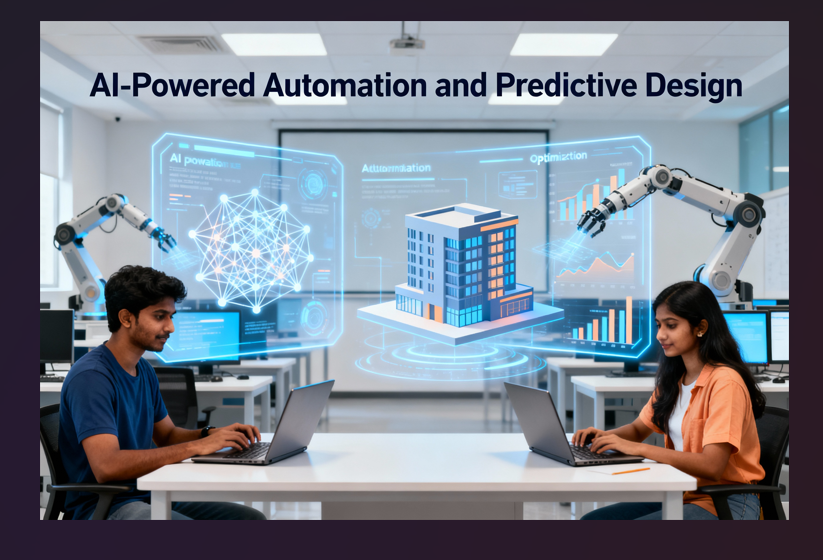
AI‑Powered Automation and Predictive Design
Designers optimize projects faster using intelligent algorithms, data‑driven insights, and automated workflows to reduce errors, save time, and deliver higher‑quality results..
Published On : 11 Jul 2025
How AI is Revolutionizing BIM with Automation and Predictive Design
Artificial intelligence is reshaping the way we use Building
Information Modeling (BIM) by automating intricate tasks and predicting
potential design challenges before they happen.
Core Advancements Enabled
by AI
1.
Intelligent Clash Detection &
Auto-Resolution
AI can analyse complex federated
models in seconds detecting conflicts across architecture, structure, and MEP.
What once required hours of manual checking is now automated. Even better, AI
recommends corrective actions, cutting up
to 80% of coordination time.
2.
Generative Design for Optimized
Layouts
Tools such
as Space maker and Test Fit allow designers to input their project goals
lighting, cost, energy efficiency, usability and let AI generate multiple
design options instantly. These smart layouts help teams explore possibilities
that would otherwise take days to produce manually.
3.
Predictive Analytics for Risk
Reduction
Machine
learning processes historical project data to forecast upcoming risks:
potential delays, budget escalation, and areas prone to clashes or rework. This
kind of foresight allows teams to act early instead of reacting late.
Transformative Impact on
Project Delivery
50–60% Faster Design Improvements.
With
repetitive tasks offloaded to AI, design teams can experiment more, refine
ideas faster, and spend more time making strategic decisions.
Up to 70% Drop in RFIs
AI’s ability to prevent clashes before construction dramatically reduces on-site confusion and contractor queries.
Higher Cost Accuracy
AI-powered
quantity take-offs reduce human error and improve forecasting, resulting in over 60% fewer cost estimation mistakes.
Conclusion
AI-enhanced
BIM is more than a digital model it becomes a smart assistant that anticipates
issues, optimizes design possibilities, and safeguards project performance.
This leap in automation and prediction signals a new era where construction
teams can operate faster, smarter, and with far greater confidence.